
ON MEDIA AND INFORMATION LITERACY AND INTERCULTURAL DIALOGUE IN THE ERA OF ARTIFICIAL INTELLIGENCE
29 AND 30 OCTOBER 2025, AT 16:00-21:30 ONLINE
Α. Organizers and ZOOM link
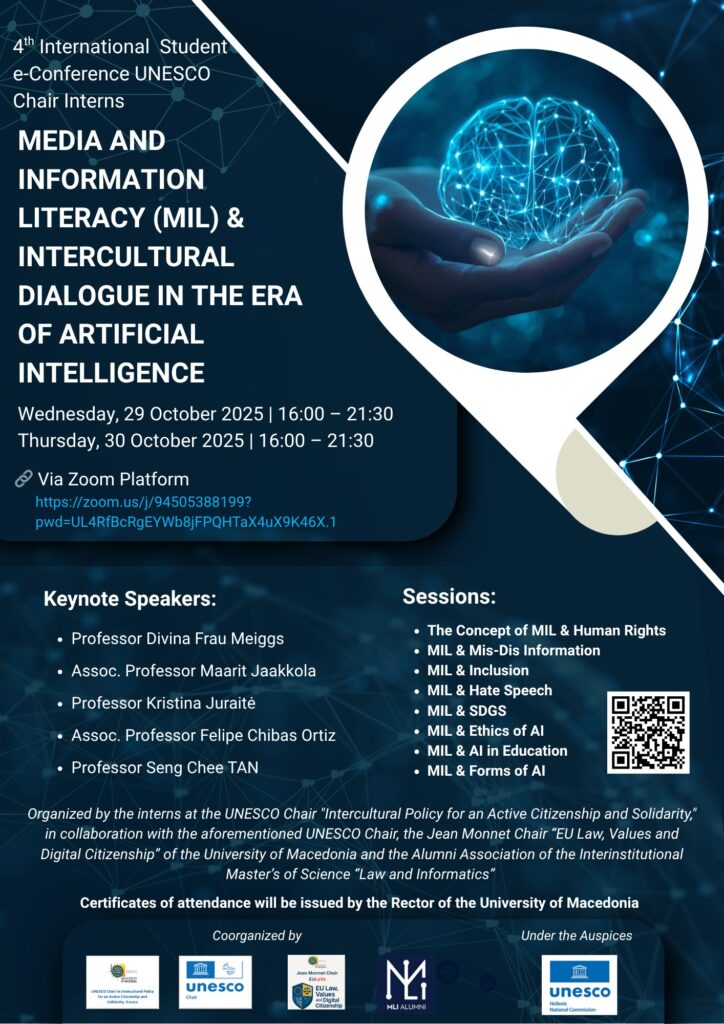
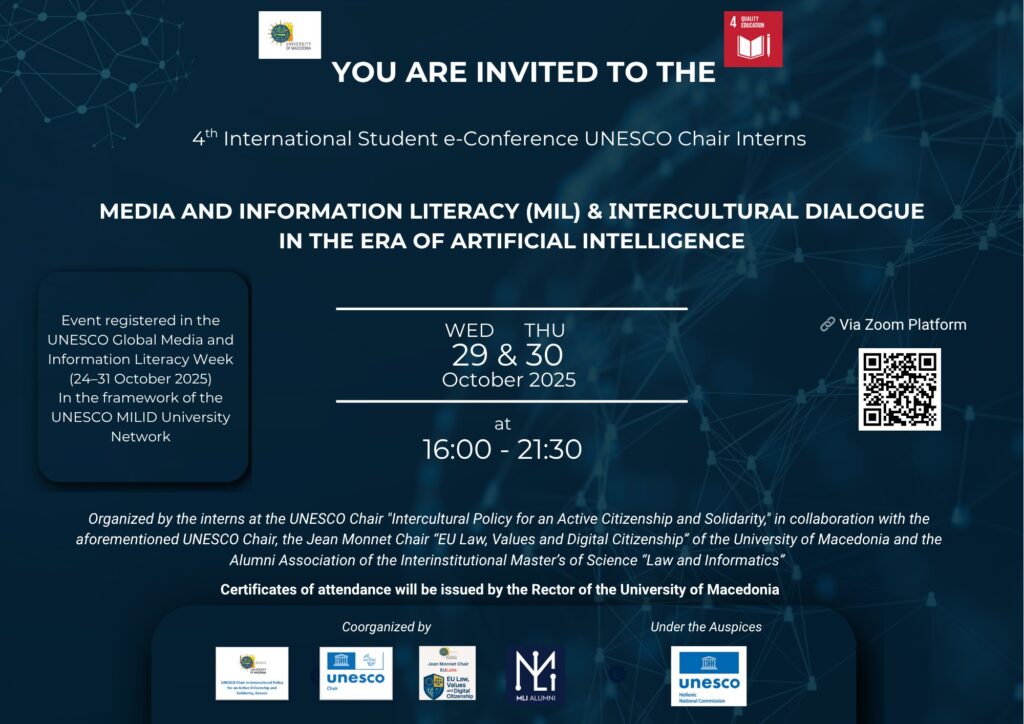
The interns of the UNESCO Chair “Intercultural Policy for an Active Citizenship and Solidarity” at the University of Macedonia in collaboration with the aforementioned UNESCO Chair, the Jean Monnet Chair “EU Law, Values and Digital Citizenship” of the University of Macedonia and the Alumni Association of the Interinstitutional Master’s of Science “Law and Informatics” (co-founded by the University of Macedonia and Democritus University of Thrace) are organizing a two-day open student conference titled:
“MEDIA AND INFORMATION LITERACY & INTERCULTURAL DIALOGUE IN THE ERA OF ARTIFICIAL INTELLIGENCE”
The conference will be held online free-of-charge on Wednesday, 29th October and Thursday 30th October 2025, hours 16:00-21:30 respectively. The Conference is under the auspices of the Hellenic National Commission for UNESCO.
The ZOOM link for those interested in participating in the Conference is:
https://zoom.us/j/94505388199?pwd=UL4RfBcRgEYWb8jFPQHTaX4uX9K46X.1
Everybody is welcome. Certificates of attendance will be signed by the Rector of the University of Macedonia.
Β. Concept Note
The conference is registered as an event of the UNESCO Global MIL Week and is organized in the framework of the UNESCO-UNAOC MILID University Network, in which the University of Macedonia is a full member, the only one from Greece.
In addition, it is organized in the framework of the Global MIL Alliance in which the UNESCO Chair of Intercultural Policy for an Active Citizenship and Solidarity is a member.
The international online student conference “Media and Information Literacy & Intercultural Dialogue in the Era of AI” seeks to underscore the central role of media and information literacy in fostering responsible, ethical, and critically informed participation in the digital age. At the same, it emphasizes the significance of intercultural dialogue as a cornerstone for social cohesion, inclusivity, and mutual understanding across diverse cultural and societal contexts.
The conference aims to develop skills, know-how and attitudes that will contribute to the development of initiatives, actions, programs and partnerships regarding media and information literacy by promoting: a) freedom of expression, b) freedom of information and free flow of ideas and knowledge, c) citizen participation, and d) understanding and reconciliation between cultures on a global level. It also aims to contribute to Education, Culture and Democracy within the framework of the 17 Global Sustainable Development Goals (mainly promoting SDG4 & SDG16, but also SDG10, SDG11 & SDG17).
It is organized with the purpose of advancing academic dialogue while also engaging the wider civil society in a constructive reflection on the transformative impact of artificial intelligence on communication, information practices, and intercultural relations.
The conference is addressed to students, academics and researchers, teachers of all levels, educational institutions, pupils, local government bodies (region and municipalities) and more broadly to the civil society.
The conference promotes Literacyin Media and Information with the goal of increasing the resilience and sustainability of cities through the utilization of technologies, creativity and innovation and the promotion of intercultural dialogue, human rights and participatory democracy in the era of AI.
By bringing together students, young researchers, and representatives of civil society from different cultural and disciplinary backgrounds, the event aspires to provide a platform for the exchange of scholarly perspectives, the development of innovative approaches, and the strengthening of international academic cooperation, while also contributing to the promotion of active, informed, and participatory citizenship.
C. Structure of the Conference
The conference consists of the welcome session and eight sessions:
1.The concept of Media and Information Literacy (ΜΙL) & Human Rights
2. Media and Information Literacy (ΜΙL) & Mis-Disinformation
3. Media and Information Literacy (ΜΙL) & Inclusion
4. Media and Information Literacy (ΜΙL) & Hate Speech
5. Media and Information Literacy (ΜΙL) & SDGS
6. Media and Information Literacy (ΜΙL) & Ethics of AI
7. Media and Information Literacy (ΜΙL) & AI in Education
8. Media and Information Literacy (ΜΙL) & Forms of AI
D. Speakers
There is a welcoming remarks session on the first day of the conference by:
- The Rector of the University of Macedonia, Professor Stylianos D. Katranidis
- Τhe Representative of UNESCO UNITWIN, Ms. Inga Nichanian
- Τhe President of the Greek National Commission of UNESCO, Ms. A. Tzitzikosta
- The Acting Director of the UNESCO Chair for Intercultural Policy for an Active Citizenship and Solidarity, Professor Evgenia Alexandropoulou, Member of the Board of Directors, and former Vice Rector of the University of Macedonia, Director of the Interinstitutional Programme of Postgraduate Studies in Law and Informatics.
The 12 interns of the UNESCO Chair of Intercultural Policy will present their research results, as part of their internship for the Academic Year 2024-25. Their presentations will be framed by lectures and presentations of renowned academics, as well as experts, educators, alumni of the Interinstitutional Master’s Programme on “Law and Informatics”, researchers and research associates of the UNESCO Chair and the Jean Monnet Chair EULaVa.he UNESCO Chair and the Jean Monnet Chair EULaVa.
The speakers are the following:
Four keynote speakers from 4 foreign universities in four different countries, members of the UNESCO MILID Network:
- Professor Divina Frau Meiggs, University of Sorbonne Nouvelle, Paris, France, UNESCO Chair “Savoir-Devenir in Sustainable Digital Development”
- Assoc. Professor Maarit Jaakkola, Co-Director of the Nordic Centre for Media Research (Nordicom), University of Gothenburg, Coordinator of the MIL ID Universities Network
- Professor Kristina Juraitė, UNESCO Chair on Media and Information Literacy for Inclusive Knowledge Societies, Vytautas Magnus University, Lithuania
- Assoc. Professor Felipe Chibas Ortiz, University of São Paulo – USP, Coordinator of the Research Group Toth, CRIARCOM of CEACOM, Regional Representative for Latin America UNESCO MIL Alliance, Coleader UNESCO MIL Cities Network project
A Special Guest Speaker
- Professor Seng Chee TAN, Associate Dean & Co-chair of AI@NIE, National Institute of Education, Nanyang Technological University, Singapore
Faculty members of the University of Macedonia:
- Despoina Anagnostopoulou, Professor, Department of International and European Studies, Jean Monnet Chair on EU Law, Values and Digital Citizenship, Director of the UNESCO Chair for Intercultural Policy for an Active Citizenship and Solidarity (on leave), University of Macedonia, Member of the Teaching Personnel of the Hellenic Open University and the Open University of Cyprus
- Sofia Boutsiouki, Assistant Professor (elected Associate Professor), Department of International and European Studies, University of Macedonia
Members of the Library Staff of the University of Macedonia:
- Anthi Baliou, Director of Library and Information Center, University of Macedonia, PhD Candidate in MIL studies – School of Journalism and Mass Media, Aristotle University of Thessaloniki
- Elisavet Chantavaridou, MCLIP, MSc, PhD Candidate, Library & Information Centre, University of Macedonia
- Argyro Tzorbatzaki, Librarian, MSc in public management, University of Macedonia
Research Associates of the UNESCO Chair of Intercultural Policy and/or the Jean Monnet Chair EULaVa of the University of Macedonia (in alphabetical order):
- Vera Dilari, MSc in European and International Policies in Education, Training and Research, University of Piraeus, Greening Education Partnership Focal Point, Research Associate at the UNESCO Chair of Intercultural Policy for an Active Citizenship and Solidarity, University of Macedonia
- Dr. Anastasia Psallida, BA Cl., National and Kapodistrian University of Athens, MA Soc. Aristotle University of Thessaloniki, MSc E.P., PhD, Department of International and European Studies, University of Macedonia, Postdoctoral teaching personnel at the Department of Political Sciences, Aristotle University of Thessaloniki, Internship Coordinator at the UNESCO Chair of Intercultural Policy, Researcher at the Jean Monnet Chair EULaVa, Educator and Head of International and European Programs Department, Hellenic College of Thessaloniki
- Dr. Dionysia Tsolaki, BA, MA (Open University of Cyprus), LLM, LLM (Law School, National and Kapodistrian University of Athens) PhD (Department of International and European Studies, University of Macedonia), Postdoctoral teaching personnel at the same department, Adjunct Professor (Uni-Open College), Researcher at the Jean Monnet Chair EULaVa.Open College), Researcher at the Jean Monnet Chair EULaVa.
Members of the Alumni Association of the Interinstitutional Master’s of Science “Law and Informatics” (co-founded by the University of Macedonia and Democritus University of Thrace):
- Olga Tsantila, President of the Alumni Association of the Interinstitutional Master’s Program “Law and Informatics”, Lawyer, MSc in Law and Informatics, Certified Information Privacy Professional/Europe (CIPPE/E), Member, International Association of Privacy Professionals (IAPP), Journalist, Member of the Journalists’ Union of Macedonia and Thrace Daily Newspapers (ESIEMTH).
- Magdalini Skondra, Lawyer, Certified Information Privacy Professional/Europe (CIPP/Ε), MSc Law & Informatics, University of Macedonia
- Chrysoula Andreadou, Judge at the Administrative Court of Appeals, President of the Three-Member Board of Directors of the Administrative Court of First Instance in Athens, MSc in Law and Informatics, University of Macedonia, LL.M in International Studies, Faculty of Law, Aristotle University of Thessaloniki
- Evangelia Astridou, Labour Inspector, Gender Equality & Digital Law Specialist, MSc Law & Informatics, University of Macedonia
Guest speakers from other Greek Universities, educational organisations and regulatory organizations:
- Dr Georgios Anagnostaras, Legal Expert, National Council for Radio and Television (NCRTV); Adjunct Lecturer, Athens University of Economics and Business (AUEB), Hellenic Open University (HOU), Open University of Cyprus (OUC)
- Dr Aikaterini Chrysanthopoulou, PhD in Media & News Literacy, Aristotle University of Thessaloniki, Adjunct Lecturer at Ionian University, Dept of Digital Media, Post Doc Researcher in News Literacy and Young Audiences at the Aristotle University of Thessaloniki
- Eirini Symeonidou, PhD candidate at the University of Thessaly,European Schoolnet Academy, Brussels
- Loukia Kefallinou, BA in Classical Philology, National and Kapodistrian University of Athens, Department of Ancient and Modern Greek Philology, Educator at International School of Athens, IBEN Educational Consultant/ Curriculum Developer, Member of UNESCO Associated Schools Network ASPnet, Examiner at Certificate of Attainment in Greek Language, Centre for the Greek Language
- Svetla Mavrodieva, Assessment Specialist by Cambridge Assessment English, Scientix Ambassador, International Teacher Trainer on CLIC (Content and Language Integrated Learning), Member of the EDEH (European Digital Educational Hub): “Effective, Inclusive and Ethical Artificial Intelligence in Education (AIED) Design”
Members of the Scientific Committee of the 4th International Student E- Conference:
- Despoina Anagnostopoulou, Professor of the Department of International and European Studies, University of Macedonia, Director of the UNESCO Chair (on scientific leave)
- Evgenia Alexandropoulou, Professor of the Department of Applied Informatics, University of Macedonia, Deputy Director and scientific associate of the UNESCO Chair
- Dr. Anastasia Psallida, PhD, Department of International and European Studies, University of Macedonia, scientific associate of the UNESCO Chair and coordinator of the internship
- With the collaboration of Mrs. Loukia Kefallinou, Educator, International School of Athens.
Members of the Organizing Committee of the 4th International Student E- Conference:
- Marios Nosios, PhD candidate, Department of International and European Studies, University of Macedonia
- Ioanna Kontou Founta, Postgraduate student, Department of Educational and Social Policy, University of Macedonia and Undergraduate student, Department of Applied Informatics, University of Macedonia
- Maria Ioanna Dritsa, Postgraduate student, Department of Social Sciences, University of the Aegean
- Eleni Karavasili, Postgraduate student, Department of Educational and Social Policy, University of Macedonia
- Polyxeni Fragkoudi, Undergraduate student, Department of International and European Studies, University of Macedonia
- Efthychia Chatzipapa, Undergraduate student, Department of International and European Studies, University of Macedonia
The UNESCO Chair Interns (in alphabetical order)
- Evdoxia Begou, M.Sc. in School Management and Development: Educational and Administrative Practices, National and Kapodistrian University of Athens, B.Sc. in Computer Science, University of Crete
- Eftychia Chatzipapa, Undergraduate student, Department of International and European Studies, University of Macedonia
- Gkolfo Choufta, Postgraduate student, Master’s Program in European Policies of Youth, Entrepreneurship, Education and Culture, University of Macedonia, BA, Faculty of Primary Education, Aristotle University of Thessaloniki
- Maria-Ioanna Dritsa, BA in Turkish Studies & Modern Asian Studies, Department of Economics and Political Sciences, National and Kapodistrian University of Athens, Postgraduate Student in European Societies and European Integration, Department of Social Sciences, University of the Aegean
- Polyxeni Fragkoudi, Undergraduate Student, Department of International and European Studies, University of Macedonia
- Eleni Karavasili, Postgraduate Student, Educational Sciences — Teacher Education in Innovative Teaching and Learning Approaches, University of Western Macedonia, BA, Department of Educational and Social Policy, University of Macedonia (Specialization in Lifelong Learning)
- Malvina Kontou, LLB Law School, Aristotle University of Thessaloniki, M.Sc. Food and Beverage Law, Dept. of Agriculture, Aristotle University of Thessaloniki, Ph.D.(c.) in International and European Studies, University of Macedonia, H.F.R.I. Scholar
- Ioanna Kontou Founta, Economist, Educator, Undergraduate Student in Applied Informatics, University of Macedonia, Postgraduate Student, MSc in the Sciences of Education & Lifelong Learning: Educational Administration & Leadership, Department of Educational & Social Policy, University of Macedonia
- Maria Kyrmanidou, BA Graduate Student in Educational and Social Department in University of Macedonia – Special Education Teacher and Music Teacher
- Olga Makri, School Psychologist, MSc in “Counselling Studies”, University of Hull, U.K, Postgraduate Student, MSc in “European Policies on Youth, Entrepreneurship, Education and Culture”, University of Macedonia
- Eirini Mikropoulou, ΒΑ in French Language & Literature, Faculty of Philosophy, Aristotle University of Thessaloniki
- Marios Nosios, BA International and European Studies, University of Macedonia, MA Business Analytics and Data Science, University of Macedonia, PhD Candidate in the Department of International and European Studies, University of Macedonia
See the programme here